


Add a Battery to Your Existing Solar System in San Diego
RCH Renewables is a C-10 licensed contractor (#1108682) and Tesla Certified installer that adds Tesla Powerwall 3 and Enphase batteries to existing solar systems across San Diego County, from Fallbrook and Oceanside to Carlsbad, Encinitas, and San Marcos.
Your panels were a good call. Now they are only doing half the job. Every kilowatt-hour you export at noon earns SDG&E's cheapest rate, and every one you buy back at 6 p.m. costs the most expensive. A battery closes that gap, and adding one does not touch your NEM status.
Will adding a battery kick me off NEM 2.0? No.
If your solar was approved under NEM 2.0, you keep those rates for 20 years from your interconnection date. The CPUC's own decision language is direct: the 2022 changes have “no impact on existing rooftop solar customers. Existing solar customers will maintain their current compensation rates.”
Adding storage to your existing array does not change your NEM status. The thing that can trigger a review is expanding the solar itself: the rules allow a one-time increase of up to 1 kW or 10 percent of your system size, whichever is greater. A battery is not solar capacity. We handle the interconnection paperwork so the addition is filed as exactly what it is.
One more date worth knowing: NEM 2.0 closed for good in April 2026. Nobody can get your rates again. That makes your grandfathered status worth protecting, and worth using.
How SDG&E peak hours actually price your evenings →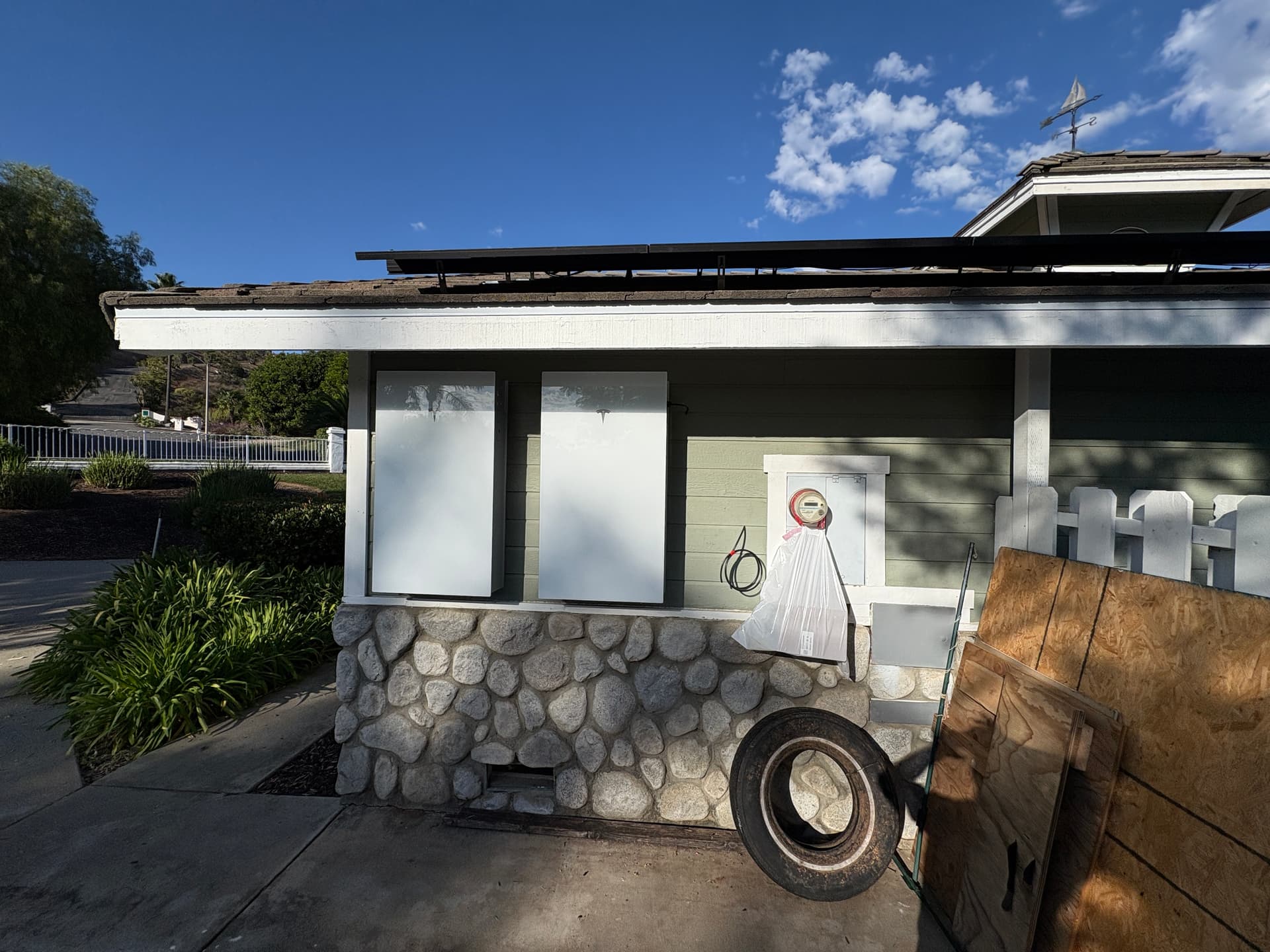
SDG&E made your noon power cheap and your evening power expensive. A battery flips that.
Two things happened this year. In April, SDG&E's average residential rate ticked up again, to 46.4 cents per kWh. In May, SDG&E made 10 a.m. to 2 p.m. a super off-peak window year-round. That second change matters more than the first if you have solar: your midday exports now earn credit at the cheapest tier of the day, so the power you sell at noon buys back roughly 20 percent less evening power than it did before May.
A battery stores the noon power you would have exported at the cheap rate and spends it into the 4-9 p.m. window at the expensive one, automatically, every day. For a home shifting 10 kWh a day, that is worth roughly $860 a year at current rates, more if your evenings run heavy on AC. No tax credit math, no rebate promises. Just rate arbitrage that works because the spread exists.
Schedule TOU-DR1, effective August 1, 2026
- Summer on-peak (4-9 PM)$0.69135 / kWh
- Summer super off-peak$0.37433 / kWh
- The spread a battery captures$0.32 / kWh
Powerwall 3 or Enphase, matched to what is on your roof
Tesla Powerwall 3, AC-coupled
From $13,729 installed. Works with any existing solar brand and inverter; your current system stays as it is and the Powerwall connects on the AC side. 13.5 kWh usable. One covers essentials through an outage, two run most homes 12-24 hours.
DC-coupled option
When it fits the system design, panels connect through the Powerwall itself. Same $13,729 base plus about $349 per MCI where rapid-shutdown hardware is required. We confirm which architecture fits during the site assessment.
Enphase IQ batteries
For homes already running Enphase microinverters that want to stay in one ecosystem. Modular sizing, same job: store midday production, cover the 4-9 p.m. window, back up your essential circuits.
We are a Tesla Certified installer and a C-10 electrical contractor (#1108682), which matters on retrofits because the work is mostly electrical: panel capacity, backup circuits, interconnection. Full product specs, runtime numbers, and warranty details live on the Tesla Powerwall 3 installation page.
No solar? A battery still pays its way.
Powerwall 3 does not need panels. It charges from the grid during SDG&E's two cheap windows, overnight and 10 a.m. to 2 p.m., and covers your home through the 4-9 p.m. peak and through outages. Same hardware, same backup, no roof work.
If you are weighing solar later, the battery installs now and the panels join it whenever you are ready. Financing options are on the financing page.
How a battery retrofit goes
01
System review
We look at your existing inverter, panel configuration, electrical panel capacity, and 12 months of SDG&E bills.
02
Design and quote
Battery count sized to the loads you want backed up. An exact number, not a starting-at price.
03
Permit and install
We pull the permit, mount the battery, wire the backup circuits, and commission the system. Most retrofits are a one-day install.
04
Interconnection
We file the paperwork with SDG&E as a storage addition, which is what protects your existing NEM status.
Battery retrofit questions, answered
Will I lose NEM 2.0 if I add a battery?
No. The CPUC's decision language is direct: the 2022 changes have no impact on existing rooftop solar customers, and existing customers maintain their current compensation rates. Adding storage to your existing array does not change your NEM status. A battery is not solar capacity, and we file the interconnection paperwork as exactly what it is.
Can I also add more panels?
Within limits. The current rules allow a one-time solar expansion of up to 1 kW or 10 percent of your original system size, whichever is greater, without triggering the new tariff. Go past that and you move to NEM 3.0 billing. We check your numbers before touching anything.
How many Powerwalls do I need?
One Powerwall 3 stores 13.5 kWh, which covers essential loads, refrigerator, internet, lights, and outlets, through a typical outage. Two units cover most North County homes for 12-24 hours including some HVAC. We size the system from your actual SDG&E usage and the loads you want backed up, not a one-size guess.
Does the battery work during an outage?
Yes, that is the point. When the grid goes down, the battery carries your backed-up circuits, and if it is paired with your solar, the panels keep recharging it while the grid is out. Your existing solar alone shuts off during an outage; adding a battery is what keeps it working.
What does it cost?
A Tesla Powerwall 3 added to existing solar starts at $13,729 installed, AC-coupled, including permits, engineering, and labor. Some installs need additional rapid-shutdown hardware at about $349 per device, which we confirm during the site assessment. Financing is available.
Your panels already bought the power. Keep it.
Free assessment of your existing system, your SDG&E plan, and what a battery would actually save you. No pressure, real numbers.
Get a Battery Retrofit Quote
Tell us what is on your roof and we will follow up with a real number, not a ballpark.
Ian Crilly
Residential Manager, RCH Renewables, C-10 Licensed (#1108682)
Last updated: August 2026