

Commercial Solar O&M Across 9 Healthcare Facilities
A regional healthcare provider operating nine facilities in North County San Diego. 978.28 kW of solar. A previous contractor who missed everything.
What did RCH find in the first two site visits at a 978 kW healthcare solar portfolio?
Four categories of failure across just two of nine sites: a failed Yaskawa Solectria inverter, a stringing error suppressing 32 kW of production, carport structural damage requiring emergency shoring, and a burnt DC combiner box. All were found through IV curve tracing, thermal imaging, and physical site walks. The previous contractor had flagged none of them.
The portfolio covers 978.28 kW across nine healthcare facilities in Escondido, North County San Diego. RCH Renewables took over the contract in 2026. All diagnostics were performed using a Solmetric IV Curve Tracer and FLIR thermal cameras under RCH's C-10 electrical contractor license (#1108682).
Production looked fine on paper. It was not fine.
A regional healthcare provider in Escondido operates nine facilities with rooftop and carport solar installations totaling 978.28 kW. The systems use Yaskawa Solectria inverters and QCell panels, mounted primarily on custom carport structures.
When RCH Renewables took over the O&M contract in 2026, the portfolio came with a history of maintenance by a previous contractor. Production numbers looked fine on paper at most sites. No one had flagged anything urgent.
That changed on the first two site visits.
RCH's inspection process does not start with the monitoring dashboard. It starts with a physical site walk, IV curve tracing on every string, and thermographic imaging across the array. The difference between checking a dashboard and checking every connection is the difference between finding problems and finding nothing.
Biannual inspections, yearly cleanings, and reactive dispatch across nine sites.
RCH's contract with this healthcare provider covers biannual inspections (one visual, one in-depth) and yearly panel cleanings across all nine sites. The contract also includes reactive dispatch for any issues identified between scheduled visits.
The first inspection cycle is still underway. RCH has completed visits at two of the nine sites so far. The scope of issues found in those first two visits reshaped the entire maintenance plan.
Biannual inspections across 9 sites (one visual, one in-depth per year)
Yearly panel cleanings
Reactive maintenance and emergency response
Full diagnostic reporting with IV curve tracing and thermographic imaging
All work is performed by RCH's crew under the company 's C-10 electrical contractor license (#1108682).
What does commercial solar O&M cost?
Commercial solar O&M typically runs $8 to $25 per kW-DC-year. Reactive-only contracts sit at the lower end. Full-service contracts that include biannual inspections, yearly panel cleanings, IV curve tracing, thermal imaging, and reactive dispatch sit at the higher end. Multi-site portfolios earn volume pricing. See our full commercial solar O&M services for scope details.
How do you find problems a previous solar O&M contractor missed?
You look harder.
IV curve tracing is a string-level diagnostic that plots current against voltage and compares the result to a module's expected curve. It identifies degradation, mismatched strings, and stringing errors that never show up as a monitoring alert because they reduce output without creating a fault.
RCH uses a Solmetric IV Curve Tracer to test every string in the array, not just the ones that monitoring flags as underperforming. That catches issues that show up as subtle production losses: degraded connections, partial shading effects that shift seasonally, and stringing errors that reduce output without creating a fault.
Thermographic imaging uses an infrared camera to show the temperature of every module in the array. FLIR thermal cameras reveal hotspots that indicate failing cells, loose connections, or current mismatch between strings. A module running 15 degrees hotter than its neighbors is not visible from the ground. It is visible through thermal imaging.
The previous O&M contractor on these sites did not use either method. Their inspections were visual and dashboard-based. That approach catches obvious failures. It does not catch the issues that slowly erode production over months.
Inverter failure (Yaskawa Solectria)
One inverter had failed completely. Because other inverters on the same site were still producing, overall site output looked acceptable on the monitoring dashboard. The failure was only identified during the physical site walk and equipment-level inspection.
Carport structural damage
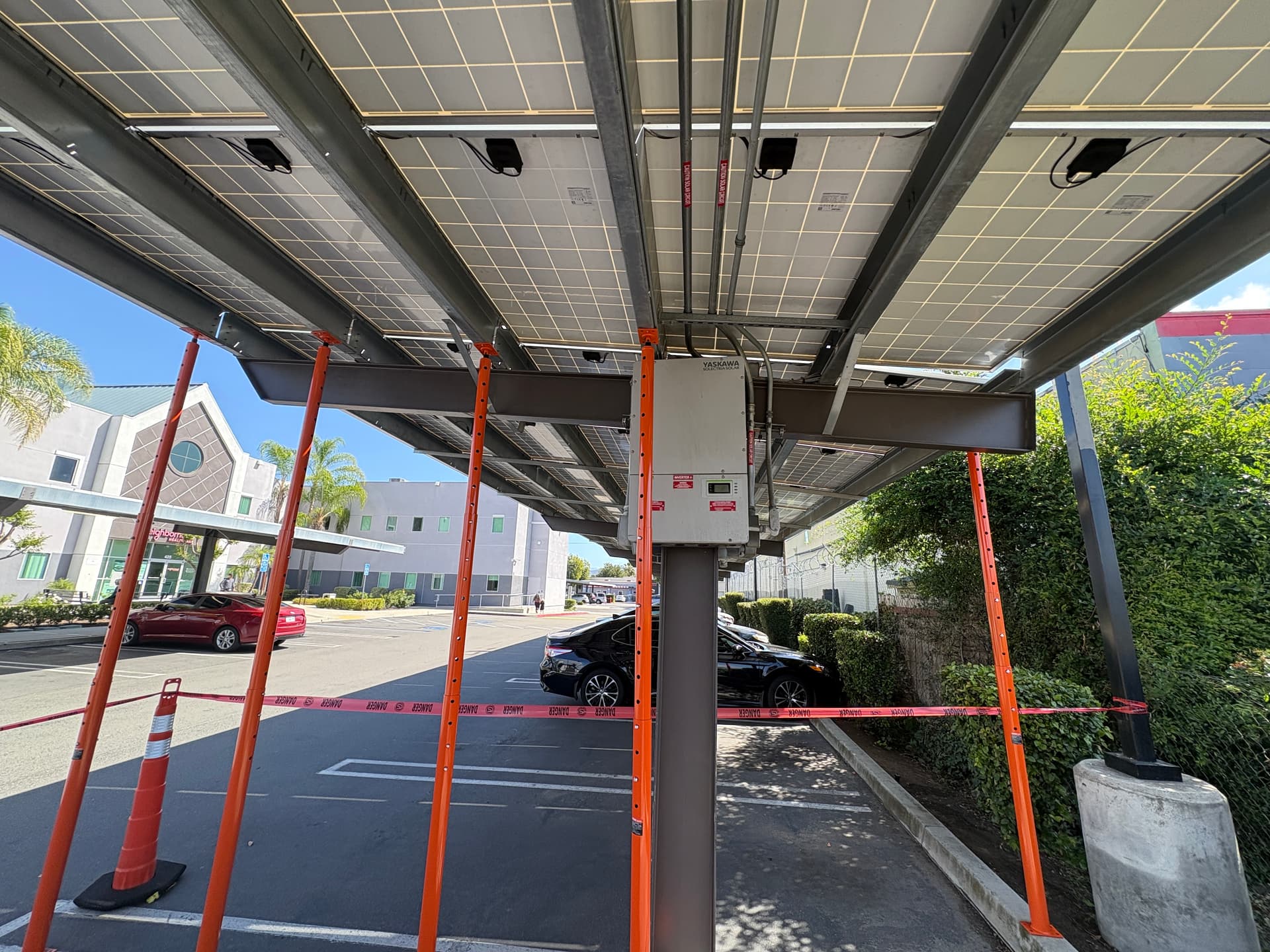
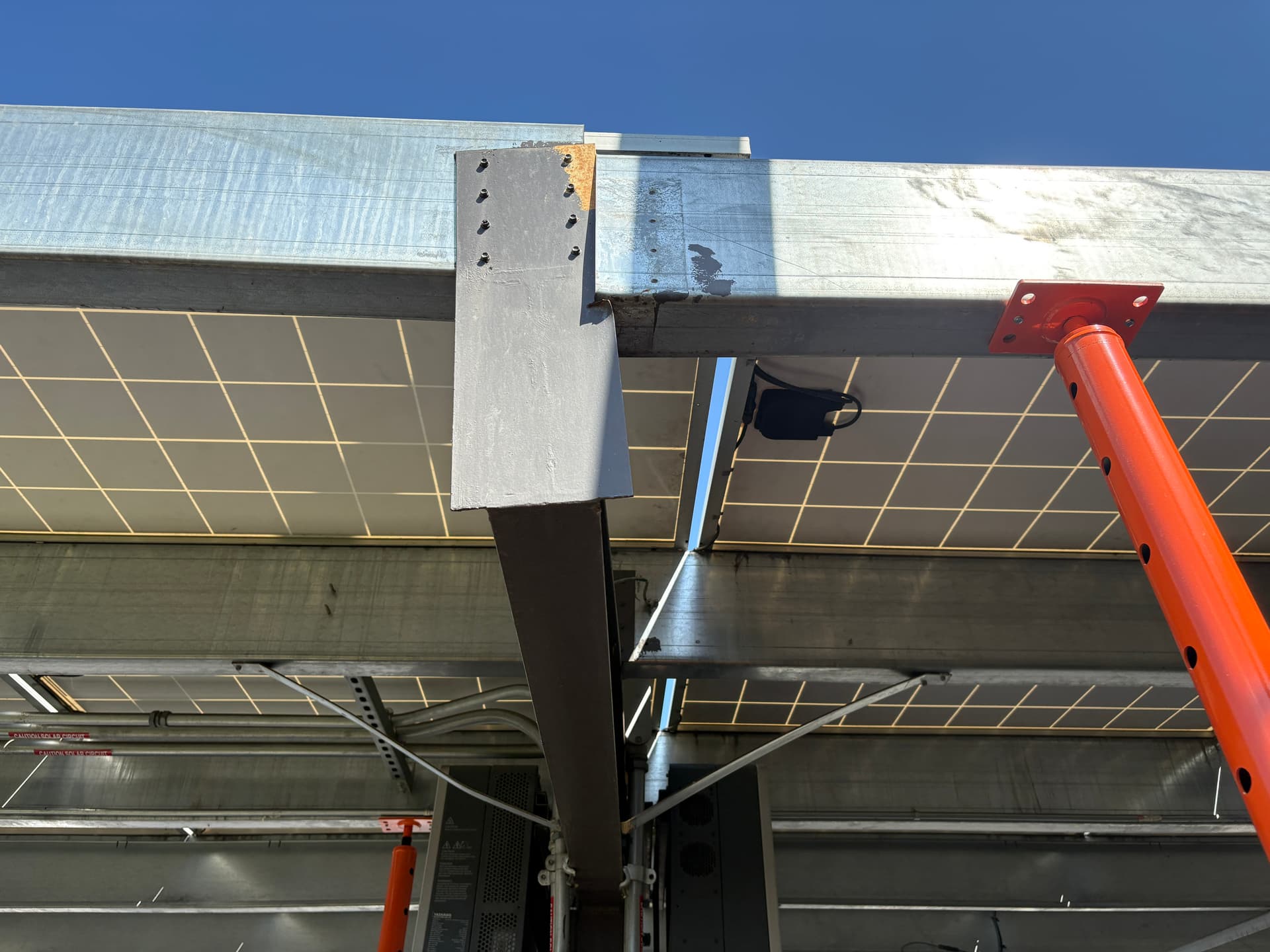
During a site walk for an underproduction call, the crew discovered structural damage to a carport mounting system. This was not related to the underproduction alert. It was found because RCH's site walk protocol includes structural inspection of mounting systems, not just electrical components. The carport required emergency shoring to prevent further damage.
Stringing issue reducing production by 32 kW
IV curve tracing at one site revealed a stringing configuration error that had been reducing output since installation. The fix restored 32 kW of production to the array.
DC combiner box failure
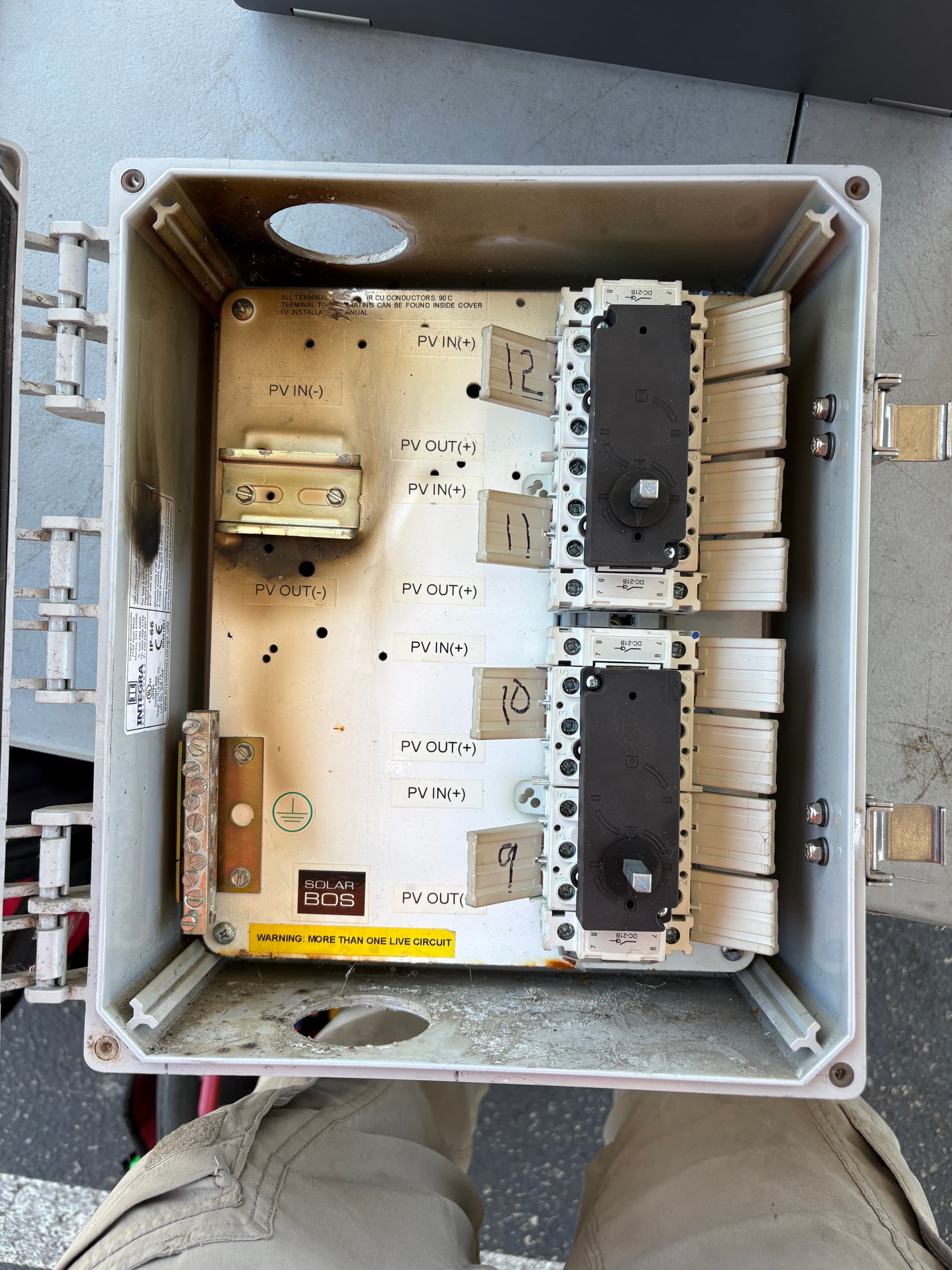
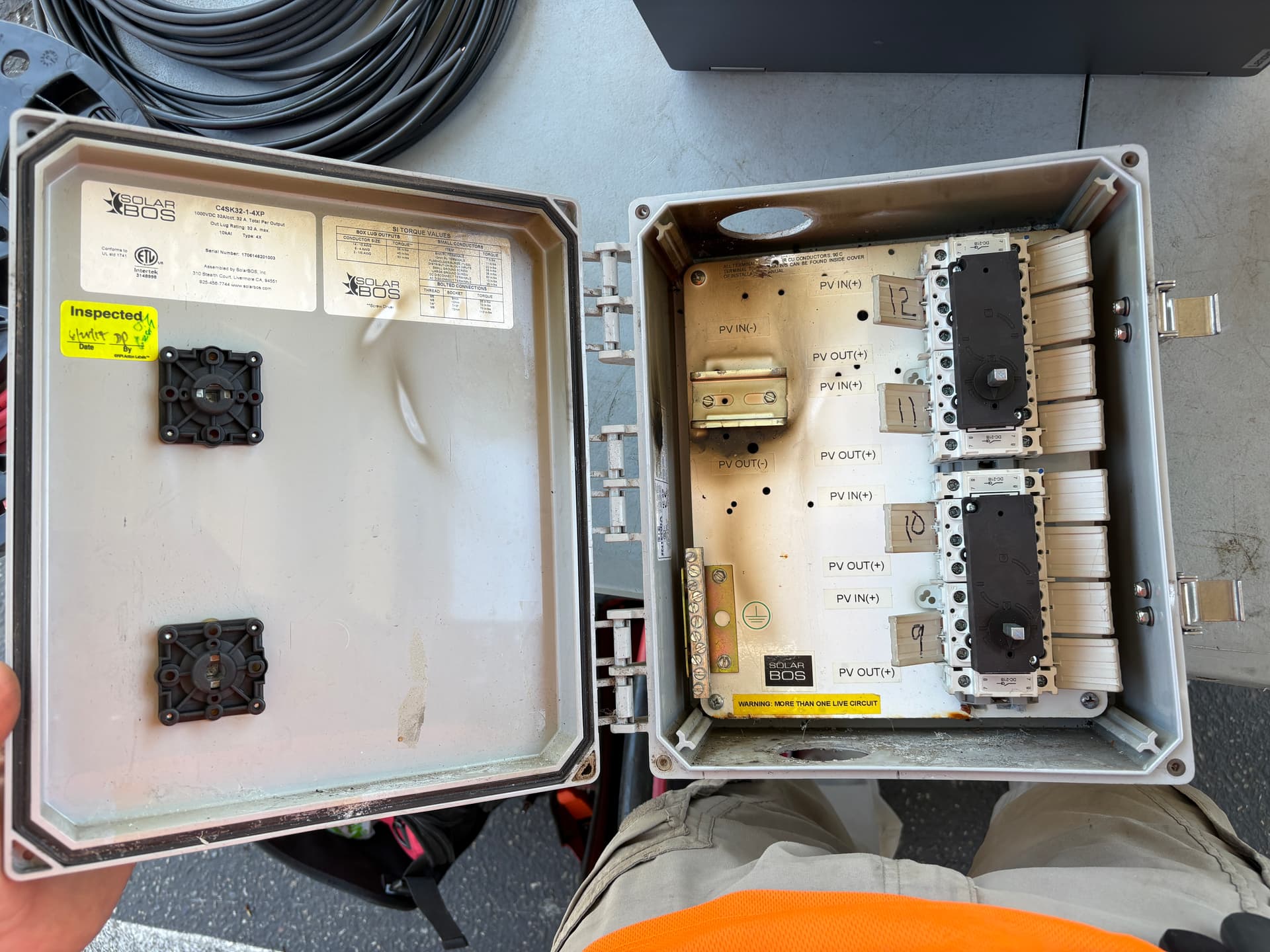
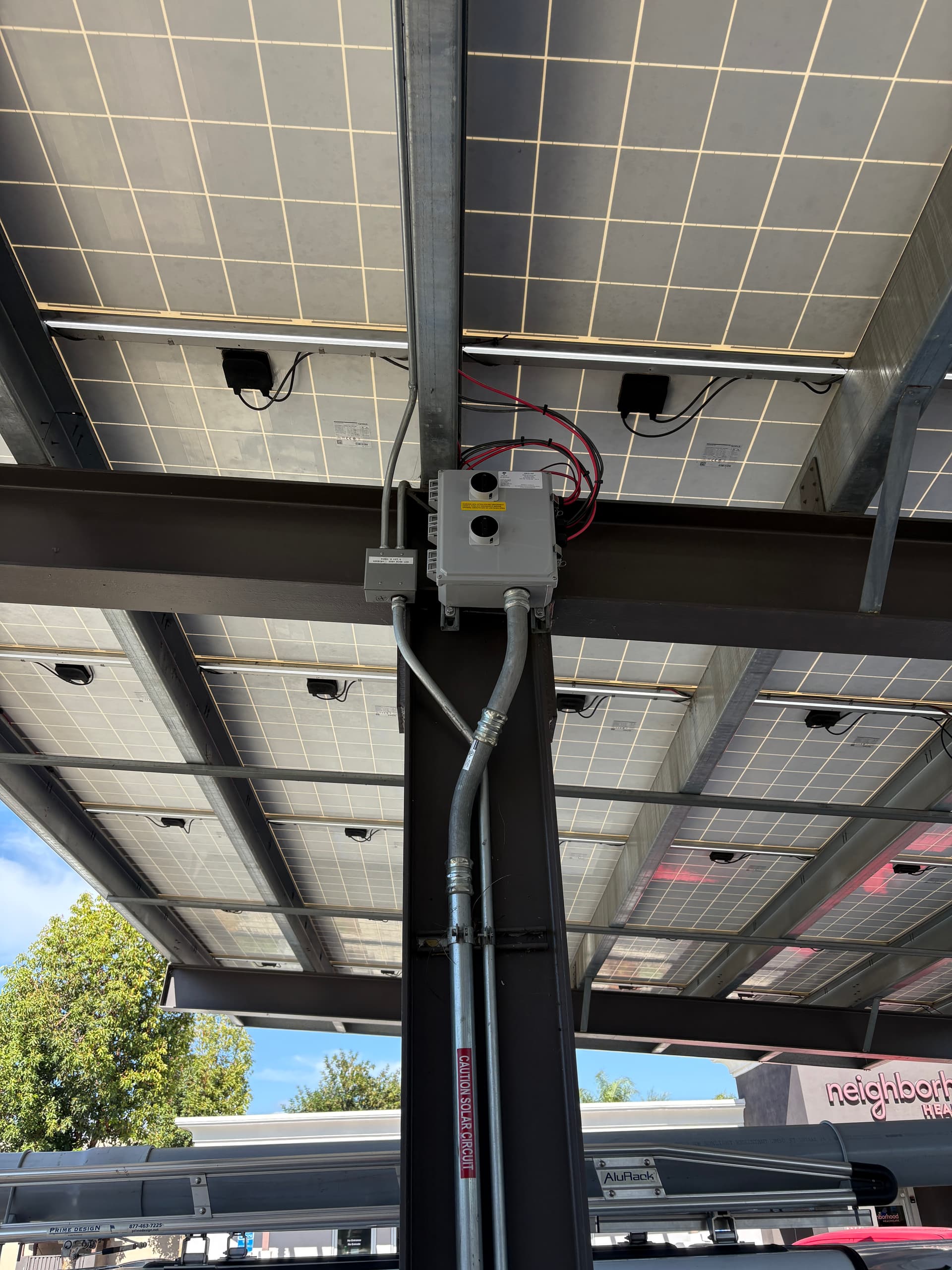
A DC combiner box is the enclosure where multiple solar strings wire together before feeding the inverter. During a full component-level inspection, the team discovered water intrusion inside a DC combiner box mounted under one of the carports. The previous installers had used incorrect fittings and cut an oversized conduit entry hole directly above live electrical components. With the box exposed under the carport, rainwater slowly entered over time. By the time RCH opened the enclosure, the interior had experienced an electrical short and fire. The bus bars, fuses, and wiring inside were practically fused together. The combiner box is currently being replaced as of April 2026.
Four distinct categories of failure, found across just two of nine sites. None had been identified by the previous contractor.
Site walks catch what dashboards never will.
The carport structural damage is the clearest example. RCH was dispatched to one of the nine sites for an underproduction alert. The underproduction issue was a separate electrical problem. But during the site walk, the crew identified carport structural damage that had nothing to do with the original dispatch.
A contractor who only investigates what monitoring flags will solve the electrical issue and leave. A contractor who walks the site catches the structural issue too.
This is the argument for comprehensive site walks over dashboard-driven maintenance. The dashboard tells you about electrical output. It tells you nothing about the physical condition of the mounting structures, the state of wiring runs, or the condition of junction boxes and combiners.
Physical site walk of all arrays and mounting structures
IV curve tracing on every string (Solmetric IV Curve Tracer)
Thermographic imaging across all modules (FLIR thermal cameras)
Equipment-level inspection of inverters, combiners, disconnects, and wiring
Structural inspection of carport and rooftop mounting systems
What RCH has found and fixed so far
2 of 9 sites visited. The contract started in 2026.
Cost of inaction (inverter failure alone)
Estimate based on typical SDG&E commercial rates and the failed inverter's rated output. The undetected failure would have cost approximately $5,400 in lost production over six months. And that is just one inverter at one of nine sites.
| Issue | Status | Impact |
|---|---|---|
| Inverter failure (Yaskawa Solectria) | Replaced | ~$5,400 in avoided lost production over 6 months |
| Stringing configuration error | Fixed | 32 kW of production restored |
| Carport structural damage | Shored | Structural failure risk eliminated |
| DC combiner box failure (water intrusion, electrical fire) | Replacement in progress (April 2026) | Preventing further arc fault damage and potential system fire |
The contract started in 2026. Two visits across nine sites. RCH is still completing the first inspection cycle, and the issues already identified represent tens of thousands of dollars in avoided losses and prevented failures.
Seven more sites to inspect.
Landon Raster
President, RCH Renewables | C-10 Licensed Electrical Contractor (#1108682)
“Two site visits. Four categories of failure that nobody had caught. That is what happens when you actually walk the site and test every string.”
Think your commercial solar systems are running fine?
RCH Renewables found four categories of failure across just two site visits at this healthcare portfolio. If your current O&M contractor relies on dashboard monitoring alone, there are problems they are not seeing. Contact Landon for a site assessment.
Related Projects
Learn more about our commercial solar O&M services or browse commercial solar maintenance contracts.
Schedule a site assessment.
Commercial inquiries go directly to Landon. Fill this out with your site details and we will follow up within one business day.